Area 01
Energy, equipment, and grid flexibility
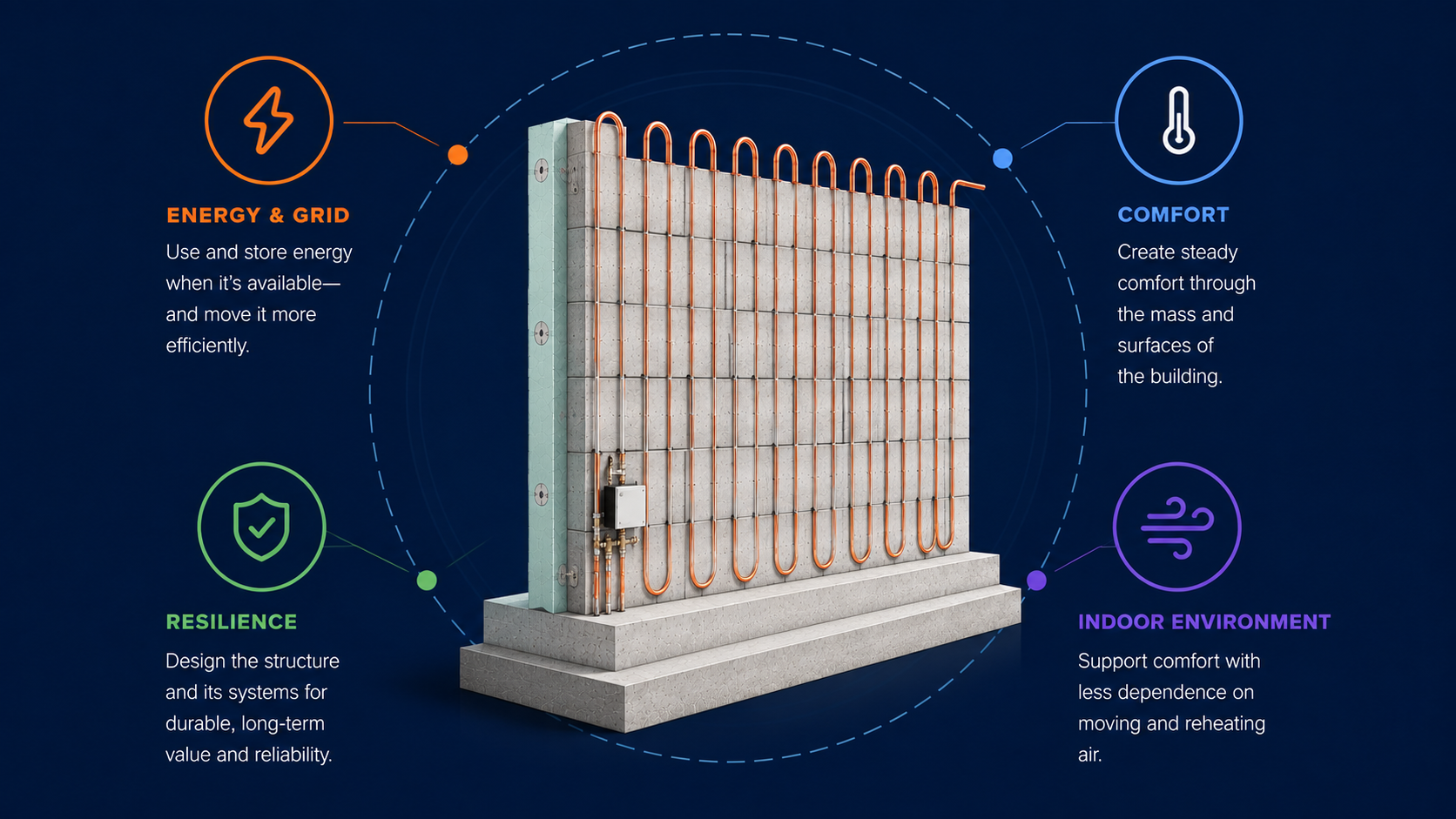
Lower operating temperatures, off-peak charging, and building-scale thermal storage create opportunities to reduce demand and use renewable energy more effectively.
Lower-temperature operation may improve heat-pump efficiency and make off-peak thermal charging practical.
TWT is designed to circulate water at roughly 67–75°F rather than the much hotter supply temperatures common to conventional emitters. The founder’s model estimates a COP of 5.5–7.5+ and an efficiency improvement of approximately 39–60%, while the concrete mass allows energy to be stored when grid demand is lower.
Founder-modeled estimates; whole-building testing is required before these figures can be treated as performance outcomes.
A low-temperature hydronic loop can make solar heat easier to collect and use.
Because TWT can accept useful heat at relatively low water temperatures, collectors may operate across a wider and more efficient range. Founder analysis estimates more than a 50% seasonal improvement compared with higher-temperature collection strategies.
The estimate depends on climate, collector design, controls, orientation, and system configuration.
Lower collection temperatures may extend useful solar collection earlier, later, and through marginal conditions.
The system may be able to gather heat during lower-angle sunlight, hazy weather, or partly cloudy periods when a high-temperature system would not produce useful output. Stored energy can then be redistributed when it is needed.
Water can move thermal energy with less distribution loss and less air movement than ducted systems.
The founder’s engineering analysis estimates that liquid circulation may require only 10–15% of the distribution energy used by comparable forced-air delivery. Hydronic routing also avoids duct leakage and can pair well with photovoltaics, off-grid systems, and emergency operation.
Actual pumping and system energy will depend on loop design, controls, pressure drop, equipment, and building conditions.
Low water temperatures may reduce the lift required from ground-source equipment.
Founder modeling estimates a 30–50% COP gain and the possibility of smaller ground loops, wells, and heat-pump tonnage. The thermal mass can also spread loads over time, which may reduce short peak demands.
These are system-level projections, not field-measured sizing or performance guarantees.
The building’s mass can be charged when electricity is cleaner, less expensive, or more available.
Smaller equipment loads, efficient hydronic delivery, and thermal storage may let controls shift heating or cooling away from grid peaks without sacrificing comfort. This could support time-of-use strategies and demand-response programs.
Radiant surfaces exchange heat directly with people and objects instead of relying primarily on heated air.
When doors open or ventilation air is exchanged, the stored energy remains in the concrete structure. That may reduce the amount of useful heat carried out of the building with escaping air and help the space recover more steadily.