THE FOUNDATION OF TWT

Evidence. Modeled.
Independently checked.

TWT's performance is grounded in building science, developed through founder-led engineering, and supported by an independent university thermal-wall model whose relevant calculation closely matched the founder's work.

Established physics

Built on proven principles of heat transfer, radiant exchange, thermal mass, and insulation.

Founder-developed models

Dozens of scenarios across climates, controls, equipment, and system configurations.

Independently checked

The independent university analysis achieved 98% agreement with the founder model on the relevant calculation.

Clear scope

The core wall thermal-storage and heat-delivery principle has been independently examined. Whole-building demonstration is next.

EVIDENCE AT A GLANCE

What the evidence establishes

Key results from independent analysis and founder modeling.

Explore full evidence
MODELED OPERATING RANGE65–75°F

Low-temperature wall operation used throughout TWT system modeling.

INDEPENDENT MODEL RESULT~5 hours

Stored heat delivery after the six-hour solar-charging period.

INDEPENDENT AGREEMENT98%

Agreement between the independent analysis and founder model for the relevant heat-flux calculation.

MODEL CONDITIONS6 hours

Solar energy input used in the independent comparison.

Important: Independent analysis covers wall thermal storage and heat delivery only. It does not evaluate solar collectors, heat-pump performance, controls, floor storage, or whole-building integration. Those are the focus of the next phase.

See boundaries

INDEPENDENT ANALYSIS RESULT

The independent analysis that separates TWT from a standard ICF

The University of Southern Indiana compared the TWT exterior-insulation principle with conventional two-sided insulated concrete construction under the same severe winter conditions.

TWT exterior-insulation wallInterior surface rose above room temperature.
Delivered stored heat for approximately five hours after solar input ended.
Conventional two-sided ICFInterior insulation prevented the stored energy from reaching the occupied space.
Bottom lineInsulation placement determines whether the concrete merely contains thermal mass—or actively stores and delivers energy to the room.
Explore modeled scenarios
Modeled wall performanceDaytime heat, released after sunset.

0°F outside · 72°F inside · 6 hours of solar input
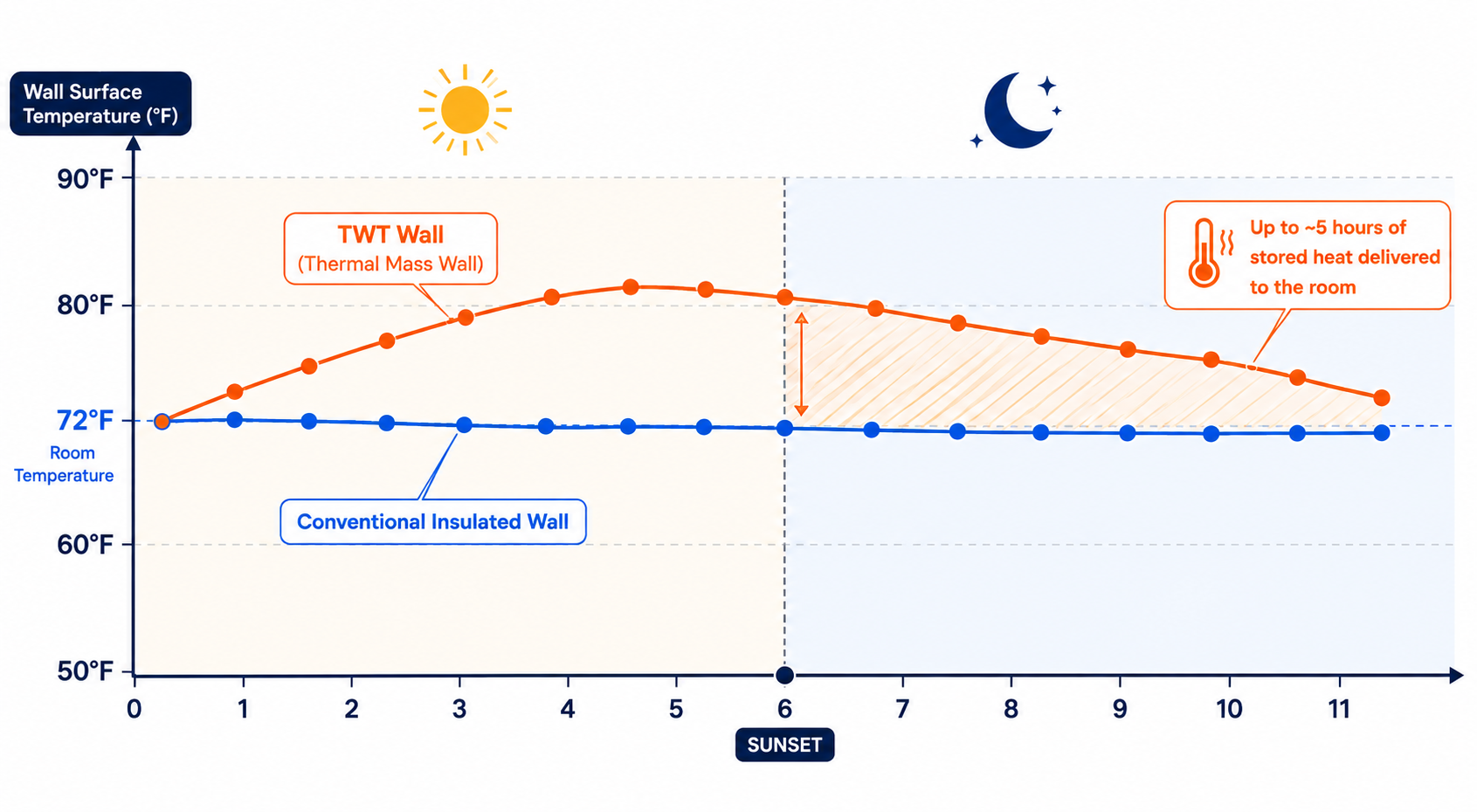
TWT thermal mass wallConventional insulated wall
Modeled wall surface temperature graph showing the Thermal Wall holding heat above room temperature after sunset

Up to ~5 hoursof stored heat delivered to the room after solar input ends.

Independent model by Dr. Brandon Field, University of Southern Indiana, March 2016. One-dimensional transient finite-difference wall model. Read technical note

FROM SUNLIGHT TO COMFORT

A wall that works with the rhythm of the day.

Thermal Wall Technology captures available solar energy, holds it within the concrete mass, and releases it gradually after the sun goes down.

01Day

Sunlight charges the wall

Solar energy warms the concrete wall surface and begins charging the thermal mass.
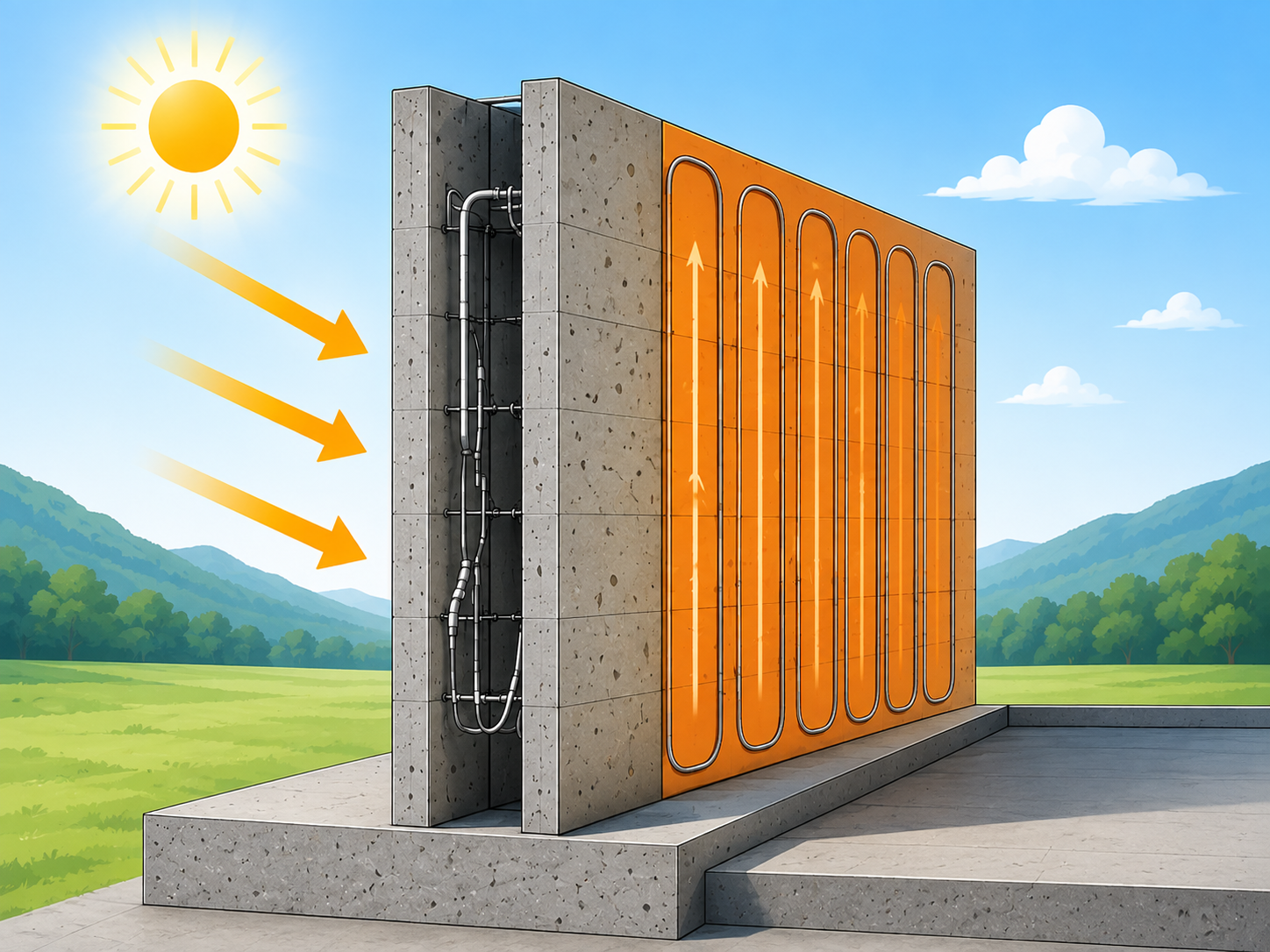
Sunlight warming a Thermal Wall
02Evening

Heat settles into the mass

As solar input fades, the wall retains thermal energy within the concrete mass.
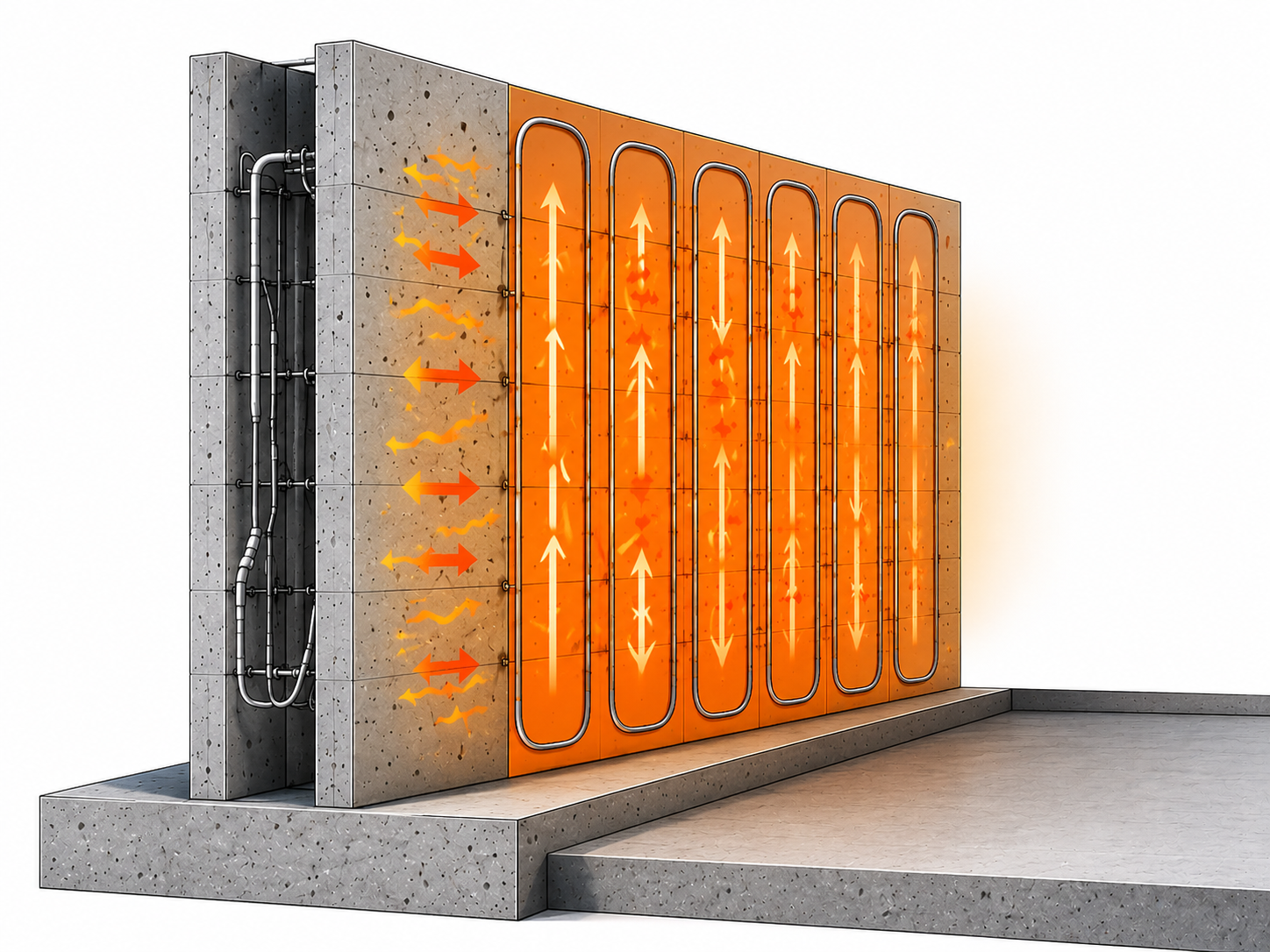
Thermal energy stored within a Thermal Wall
03Night

Stored heat returns indoors

After sunset, the stored heat radiates back toward the occupied space when it is needed.
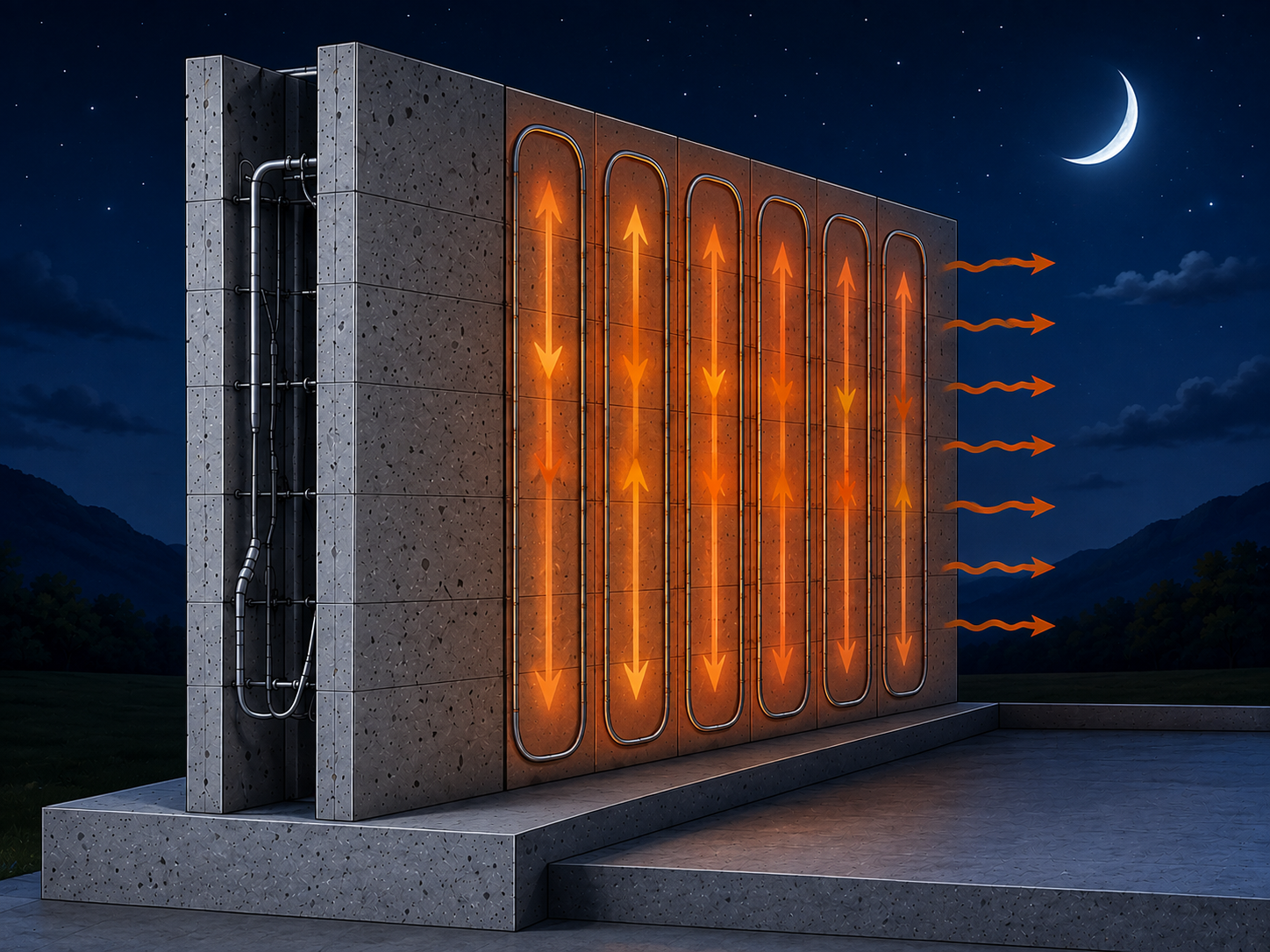
Stored heat radiating from a Thermal Wall at night

SCOPE & NEXT STEPS

Clear evidence. Clear boundaries.

The current analysis validates the core wall principle while keeping broader system claims separate until they can be measured through a full demonstration program.

01INDEPENDENTLY EXAMINED

What the independent analysis examined

  • Wall thermal storage and delivery
  • One-sided versus two-sided insulation placement
  • Response under the defined 0°F / 72°F scenario
  • Six-hour modeled solar loading
  • 98% agreement between the independent analysis and founder model
02FOUNDER MODELING

What system modeling addresses

  • Modeled 65–75°F operating range
  • Wall and floor system scenarios
  • Controls, equipment, and climate configurations
  • Potential system integration pathways
03VALIDATION ROADMAP

What remains to be measured

  • Whole-building seasonal performance
  • Real-world installation variables
  • Collector, heat pump, and HVAC performance claims
  • Long-term material behavior
  • Economics, insurance, or medical cost impacts

Next milestoneThe demonstration program is designed to close these gaps.See the roadmap

EXPLORE THE DETAILS

All the data, methods,
and references.

For researchers, engineers, builders, and reviewers who want to explore every detail behind the results.

Evidence in detail

Full results, charts, comparisons, and performance summaries.

View evidence

Modeling & methods

Inputs, material properties, equations, and solver setup.

View methods

Assumptions & boundaries

Scenario definitions, limitations, and what’s not included.

View assumptions

TWT is patented and trade secret protected. All modeling and analysis were performed by the founder and independently reviewed by the University of Southern Indiana. The technology is not yet widely commercialized.

Legal & IP